.jpeg)
The single best approach to B2B list building in 2026 combines an ICP-driven targeting model, verified and enriched contact data, and deliverability controls like warm-up and suppression management. The workflow runs in six steps: define criteria, collect, verify, enrich, segment, and send safely. Regulations like CAN-SPAM and tools like PlusVibe shape how this plays out in practice.
TL;DR:
- Build the ICP around industry, revenue band, headcount, job function, and seniority, then rank matching contacts by intent signals such as pricing guide downloads.
- Verify syntax, domain activity, and mailbox status in sequence; separately review catch all domains and role addresses because mailbox probes cannot confirm an individual.
- Test new sources on 200 to 300 records against a trusted source for two to three weeks, tracking delivery, bounces, replies, and qualified opportunities.
- B2B lists decay roughly 25% annually, so reverify emails older than six months, review unengaged contacts after 90 days, and refresh segments quarterly.
Table of Contents
- A Repeatable Framework for Targeted B2B List Building
- Channel-by-Channel Tactics for Building Your List
- Verifying and Enriching Contacts Before You Send
- From Collection to CRM: The Integration Workflow
- List Hygiene and the Deliverability Basics That Protect Your Sends
- Proving a List Source Before You Scale It
- Practitioner Checks That Cut Bounces and Lift Replies
- Keeping Your List Fresh Instead of Letting It Go Stale
- Why Integration and Deliverability Beat Brute-Force Volume
- How PlusVibe Supports List Building and Deliverability
- FAQ
- Sources
A Repeatable Framework for Targeted B2B List Building
Before you collect a single contact, define what a good one looks like. Your ideal customer profile should capture five fields at minimum: industry, revenue band, headcount, job function, and seniority level. Skip any one of these and you end up with a list that looks full but converts poorly.
Intent signals tell you who to prioritize within that profile. A prospect who downloaded a pricing guide, visited your site three times in a week, or attended a relevant webinar deserves outreach sooner than someone who matches your ICP on paper alone. Rank your contacts by combining fit and intent instead of treating every match the same.
Different channels produce different tradeoffs between precision and scale:
- LinkedIn sourcing tends to deliver higher-fit contacts because you can confirm seniority and function before adding anyone.
- Intent feeds and contact databases deliver higher volume but need heavier verification before use.
- Owned opt-ins (webinars, gated content) produce smaller lists with built-in consent and higher baseline engagement.
- Website scraping fills gaps at scale but introduces the most noise and needs the most cleanup.
These gates keep you from pouring budget into a list that looked promising but performs poorly once it hits real inboxes.
Channel-by-Channel Tactics for Building Your List
Each channel rewards a slightly different technique, and mixing them deliberately beats relying on just one.
- Owned channels: design gated content and webinar registration forms with progressive profiling, asking for role and company size upfront and deferring secondary fields (budget, timeline) to a follow-up step. This captures decision-makers without scaring off early-stage leads with a ten-field form.
- LinkedIn sourcing: build boolean search strings around title, function, and company size, then confirm seniority by checking tenure in role and team size mentioned in the profile. A manual process works for small, high-value accounts; an extension-assisted workflow supports speeding up capture when you need volume without losing targeting precision.
- Website scraping and public data: capture name, title, company domain, and public contact details, but skip anything that looks auto-generated or outdated. Spot-check a sample against the company’s own team page or LinkedIn to confirm the title still matches the person’s current role.
- Events and partnerships: ask organizers directly for attendee lists that include role and company fields, not just names and emails. Qualify each record against your ICP before adding it to outreach sequences rather than assuming event attendance alone signals fit.
- Intent feeds and contact databases: these aggregate signals like content consumption and topic research interest across many sites, which helps you spot in-market accounts you would otherwise miss. Treat them as a discovery layer that still needs verification, not a replacement for owned or sourced data.
Content marketing also feeds your owned-channel pipeline directly. A structured approach to gated content can generate consistent, higher-intent signups that need less verification work later because the people filling out your forms already identified themselves.
Verifying and Enriching Contacts Before You Send
A list is only as useful as the accuracy of what is in it, and verification is where most of that accuracy gets won or lost.
Run email verification in sequence: check syntax first, then confirm the domain is active and accepting mail, then probe the mailbox itself without sending a live message. Catch-all domains and role addresses (like info@ or sales@) need separate handling since a mailbox probe cannot confirm a specific person behind them the way it can for a named individual.
Title data rarely arrives clean. Normalize free-form titles like “Head of Growth” or “VP, Demand Gen” into consistent seniority bands (manager, director, VP, C-level) so your segmentation and messaging stay consistent across sources. Cross-reference titles against at least one other source when you can, since a title six months old might not reflect a recent promotion or move.
Firmographic enrichment should prioritize:
- Revenue band, which shapes budget assumptions and messaging tone.
- Headcount, which signals buying process complexity.
- Industry classification (NAICS or SIC code), which lets you tailor pain points to the vertical.
Pro Tip: Before buying or exporting a large list, manually review a sample of 50 to 100 records for title accuracy, email validity, and firmographic correctness. This single step catches systemic problems before they cost you a full campaign’s worth of sends.
Enrichment fields change how you message, not just who you target. A director at a 50-person company needs a different pitch than a director at a 5,000-person enterprise, even if both carry the identical job title.
From Collection to CRM: The Integration Workflow
List building fails most often not at collection but at the handoff between tools. A clean sequence protects against that:
- Define criteria (ICP fields plus intent signals).
- Collect from your chosen channels.
- Verify emails and confirm titles.
- Enrich with firmographic data.
- Deduplicate against your existing CRM records.
- Segment by fit, intent, and messaging angle.
- Export or import into your CRM or sequencing platform.
Each handoff between tools is where data commonly degrades. Map fields explicitly between your source and destination systems (title, company, revenue band, confidence score) rather than relying on default imports that might silently drop or mismatch columns. Many go-to-market teams run five to eight disconnected prospecting tools, and keeping one system as the source of truth, usually the CRM, prevents the same contact from existing in three different states across three different platforms.
Build in minimal controls at each import: automated validation that flags malformed emails or missing required fields, plus an error report you actually review rather than ignore. A prospecting and enrichment layer that writes directly into your sequencing tool removes one manual step where errors tend to creep in.
Before handing a list to SDRs, confirm it carries four things: required fields complete, a confidence flag on title and email accuracy, a source tag so you can trace performance back to the channel, and a clear segment label. This handoff checklist takes minutes to build and saves hours of SDRs chasing bad data mid-sequence.
List Hygiene and the Deliverability Basics That Protect Your Sends
A smaller, clean list consistently outperforms a larger, messy one. Reply rates drop and spam placement risk rises when a list carries stale emails, role addresses, or contacts who never opted into anything resembling your outreach.
Warm-up matters because a new or dormant sending domain has no track record with mailbox providers. Gradually increasing send volume, ideally through private, isolated sending infrastructure rather than a shared IP pool, builds that track record without tripping spam filters tied to someone else’s bad sending behavior.

Database decay happens whether you manage it or not. HubSpot notes that B2B email lists can decay by roughly 25% annually, as people change jobs, companies merge, and email addresses go stale. That decay rate is why ongoing suppression and re-engagement work matters as much as initial list building.
Core hygiene controls include:
- Suppressing hard bounces immediately and reviewing soft bounces before resending.
- Honoring opt-out requests and removing those contacts from all active sequences.
- Watching complaint rates closely since even a small spike can affect domain reputation broadly.
- Running periodic re-engagement sequences for contacts who have gone quiet, then suppressing those who still do not respond.
Set clear action thresholds: a bounce rate climbing past 3 to 5%, or a spam complaint rate above 0.1%, should trigger an immediate pause and list review rather than a wait-and-see approach.
Proving a List Source Before You Scale It
Scaling a new list source without testing it first is how teams burn sender reputation and budget at the same time. Track delivery rate, bounce rate, reply rate, qualified-opportunity rate, and eventual pipeline influence for every source you test.
Run a sample test before committing: pull 200 to 300 records from the new source, send through your normal sequence, and compare results against a known-good source over a two to three week window. If bounce and reply rates hold up, scale gradually rather than all at once.
- Cap daily sends per inbox and increase gradually (a common pattern ramps from a few dozen to several hundred over two to three weeks).
- Watch bounce and complaint rates daily during the ramp, not just at the end.
- Tag every contact with its source so pipeline results trace back cleanly.
- Pause scaling immediately if bounce rate crosses your threshold rather than finishing the batch.
Attribution ties this together: without a source tag on every contact, you cannot tell which channel is actually producing pipeline versus which one just produces volume.
Practitioner Checks That Cut Bounces and Lift Replies
A 50-record manual audit before any send catches what automated checks sometimes miss: titles that no longer match the person’s actual role, emails tied to departed employees, and company domains that quietly changed. Pull the sample, check each field by hand, and only scale the source once that spot-check comes back clean.
Small-batch sends paired with subject-line sequencing give you an early read on deliverability before committing a full list. Rotating across multiple inboxes, rather than hammering one sending address, also spreads volume in a way that looks like normal usage rather than a mass blast.
Private warm-up and isolated sending infrastructure work conceptually because they keep your domain’s reputation separate from anyone else’s sending behavior, which matters most in the first few weeks of a new domain or a new list source.
Pro Tip: Run your next new list through a 50-record manual check and a three-day small-batch send before committing the full volume. The combination surfaces most data and deliverability problems before they reach your full pipeline.
Keeping Your List Fresh Instead of Letting It Go Stale
A list that was accurate six months ago is not automatically accurate today. People change roles, companies merge or rebrand, and email addresses that worked in January can bounce by summer. Treat list maintenance as an ongoing process, not a one-time project.
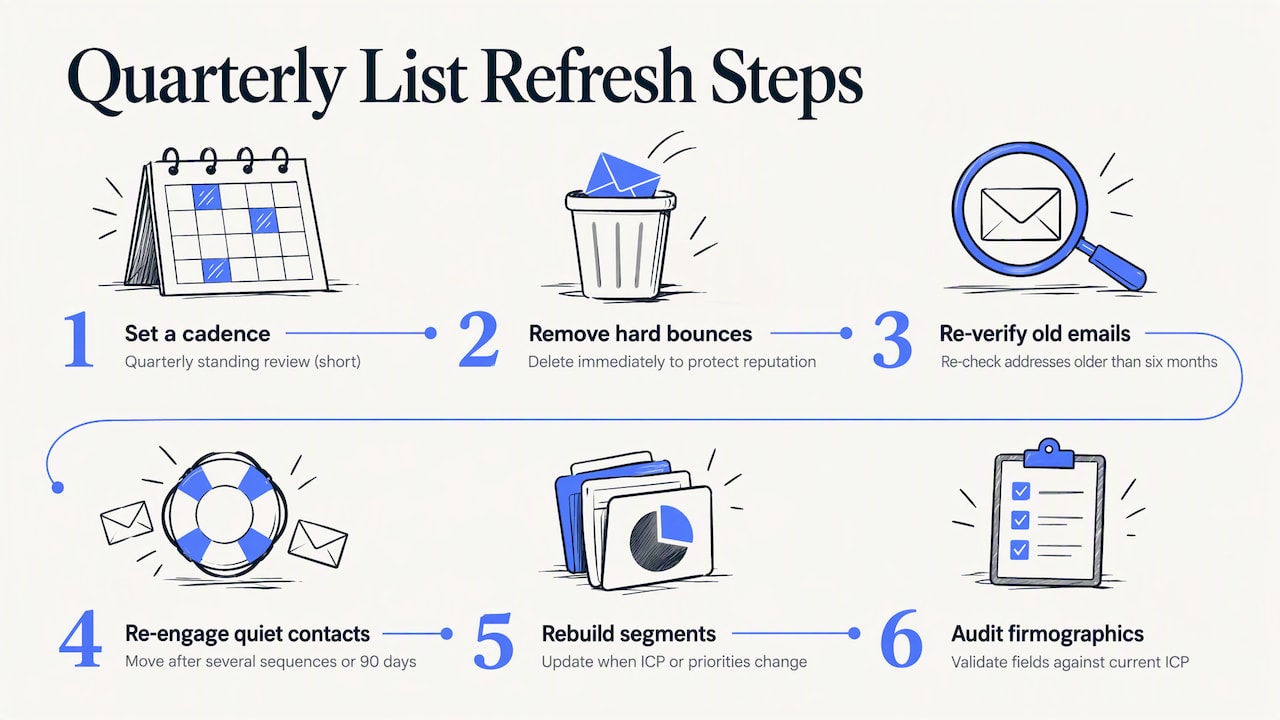
Set a recurring cadence, quarterly works for most teams, to re-verify emails and re-check titles against current sources. Contacts that have gone quiet for several sequences in a row should move into a re-engagement track rather than staying in active rotation indefinitely.
Rebuild segments as your ICP evolves, too. A list segmented around last year’s priorities might miss the account types or roles that matter most to your current pipeline goals. Revisit segment definitions at the same cadence you revisit the data itself.
A practical refresh checklist includes removing hard bounces immediately, re-verifying emails older than six months, re-checking seniority on contacts who have not engaged in 90 days, and auditing firmographic fields against your current ICP definition. Keeping a list clean on an ongoing basis protects both your sender reputation and the accuracy of the segments you built with so much care in the first place.
None of this needs to be complicated. A standing quarterly review, even a short one, catches most of the decay before it affects reply rates or deliverability.
Why Integration and Deliverability Beat Brute-Force Volume
I have watched teams chase bigger lists for years, and the ones that win consistently are not the ones with the most contacts. They are the ones whose data flows cleanly between tools and whose sending infrastructure protects reputation instead of risking it on every blast.
If I had to split a team’s time, I would put more of it into verification and deliverability than into sourcing. A smaller, accurate, well-protected list will outperform a bigger, noisy one every single time.
— Yaro
How PlusVibe Supports List Building and Deliverability
Getting a list right means nothing if it never reaches the inbox, which is exactly where we focus. The platform combines private, isolated sending infrastructure with a dedicated warm-up engine, enabling new domains and new list sources to build reputation safely instead of risking it on day one. Inbox rotation and deliverability monitoring work alongside enrichment and verification, which means the contacts collected through a Chrome extension or imported from any channel get checked and enriched before they ever hit a sequence.
Our list management features handle suppression, bounce tracking, and segmentation in one place, so your hygiene rules actually get enforced instead of living in a spreadsheet nobody checks. Compare our plans and start a free trial to see how a managed, private sending setup changes your bounce and reply rates from the first campaign.
FAQ
Is B2B business still good in 2026?
B2B outreach remains a viable growth channel in 2026, particularly when it is built on accurate targeting and deliverability controls rather than raw volume. Teams that pair an ICP-driven list with verification and warm-up infrastructure see stronger reply rates than those relying on purchased, unverified lists.
How do I build a B2B email list?
Start by defining your ICP across industry, revenue band, headcount, and job function, then collect contacts through owned opt-ins, LinkedIn sourcing, and vetted databases. Verify every email and title before sending, and protect deliverability with gradual warm-up and suppression rules, following guidance like the FTC’s CAN-SPAM compliance requirements for commercial email.
Which B2B website builder is the best?
This article focuses on list building rather than website builders, so a specific recommendation falls outside what we can verify here. For B2B marketing site needs, look at platforms with strong form integration and CRM syncing, since that connection matters more for lead capture than the builder itself.
What is a B2B in real estate?
In real estate, B2B typically refers to transactions and marketing between businesses, such as a commercial property firm selling services to developers, brokerages, or institutional investors, rather than to individual home buyers. The same list-building principles apply: verified contacts, role confirmation, and compliant outreach practices matter regardless of industry.
Sources
- CAN-SPAM Act: A Compliance Guide for Business | Federal Trade Commission
- B2B Email Marketing: How to use email to drive B2B pipeline growth