Cold outreach is weird.
Because the goal is simple. Start a conversation with someone who does not know you yet.
But the way people do cold outreach usually turns it into a noise contest. More steps. More channels. More follow ups. More “Just bubbling this up” emails that nobody asked for.
And then. The muted thread happens.
Not the angry reply. Not even the unsubscribe. Just silence. Or worse, the quiet spam complaint that tanks your sender reputation and makes the rest of your month painful.
Cadence design is the part most teams treat like an afterthought. They steal a 7 step sequence from a template library, change two words, and ship it. Then they blame the offer. Or the list. Or “the market”.
A good cadence is not just “how many touches should we send”. It is the shape of attention over time.
When to show up. When to back off. When to switch channels. When to stop.
And how to do all of that without sounding like a robot. Or a desperate person. Or a well funded spammer.
This is a practical, slightly opinionated guide to designing cadences that get replies without getting muted.
What cadence design actually means (not the definition you see on LinkedIn)
A cadence is just a planned sequence of touches. Emails, calls, LinkedIn, whatever.
Cadence design is the decision making behind it.
It answers questions like:
- How many total touches do we earn before we stop?
- How do we distribute them across days and channels?
- What is each touch trying to accomplish?
- Which touches are optional depending on signals?
- How do we protect deliverability while we scale?
Most cadences fail because they treat touches like identical units. As if Touch 1 and Touch 5 can be the same thing with a different subject line.
They cannot.
Touch 1 is “Do I belong in your inbox at all?” Touch 2 is “Did you miss it, or did you ignore it?” Touch 3 is “Let me add a little proof.” Touch 4 is “Let me make it easier to say yes.” Touch 5 is often “Let me give you a graceful exit.” Touch 6 and 7… honestly, often just ego. Or automation inertia.
So cadence design is less about “7 steps is best” and more about intention.
If your intention is “keep poking until they respond”, you will get muted.
The real enemy is not low reply rate. It is reputation decay
People think cadence mistakes show up as poor conversion.
But the first place you feel it is deliverability.
You can write good copy and still lose if your domain reputation slides. Because now you are not even being seen. Your “open rate” becomes a ghost metric. Apple MPP muddies it anyway. Replies drop. You add more volume to compensate. It gets worse.
A too aggressive cadence does a few bad things at once:
- Raises spam complaints (even tiny increases matter)
- Increases deletes without reading (a negative inbox signal)
- Triggers spam filters via pattern repetition
- Forces you to send more volume to hit goals, which compounds the issue
So if you want to talk cadence design seriously, you have to talk about deliverability as a first class constraint.
This is where platforms like PlusVibe matter, not as a shiny tool, but as guardrails. Warm up, verification, throttling, inbox rotation, deliverability checks. The boring stuff that keeps you alive.
Because the best cadence in the world does nothing if you land in spam.
Cadence is a promise. Every extra touch is you spending trust
Here is a framing that helps.
Every time you show up in someone’s inbox, you are spending a tiny amount of trust that you have not earned yet.
You are asking for attention.
If you do not give something back (clarity, relevance, proof, a good question, a reason to believe) you burn that trust.
So cadence design is also about pacing your “asks” and your “gives”.
A simple rule:
The more you touch, the more value each touch needs to earn its space.
If your Touch 4 is literally “Any thoughts?” you are spending trust and giving nothing.
That is how you get muted.
Before you design the cadence, decide what type of conversation you are starting
Not all outreach is the same.
A cadence for a transactional offer (book a demo for a clear product) is different from a cadence for a strategic relationship (partnering, co selling, hiring, enterprise).
Start by naming the conversation type:
- Quick win / tactical
“We fix X in 14 days.”
Faster pacing. Clear CTA. Fewer touches. - Curiosity based / insight led
“We noticed something in your stack, here is a gap.”
Slower pacing. More proof. More questions. - High consideration / enterprise
“This impacts revenue process, security will care.”
Longer timeline. Multi thread. More channels. - Event driven
“You just raised, hired, launched, posted.”
Short burst. Strong relevance. Stop quickly. - Account expansion / warm-ish
“We already have some connection.”
Fewer steps, more direct.
If you skip this step, you copy someone else’s cadence and wonder why it feels off.
A good default cadence is boring. That is the point
Most teams over design cadences. Too many steps. Too clever.
If you are sending cold email at scale, boring is stability.
A solid baseline for many B2B offers:
- 4 to 6 emails total
- 10 to 18 days end to end
- 1 to 2 optional non email touches (LinkedIn view, connect, comment)
- Clear stop point
- A breakup that is actually polite, not manipulative
That is it.
Not 12 steps. Not daily pings. Not “I made you a loom” when you did not.
You can always add complexity later. But you need a control sequence first.
The core cadence principle: density early, space later
Humans forget quickly. But humans also get annoyed quickly.
So the best cadence pacing often looks like this:
- A second touch fairly soon after the first (1 to 2 business days)
- Then you widen the gap (3 to 4 days)
- Then you widen again (4 to 6 days)
- Then you end it
Why it works:
- The first 48 hours catches “missed it” people
- The later spacing avoids feeling like harassment
- You avoid stacking too many sends on the same thread in a week
A simple pattern you can steal:
- Day 1: Email 1
- Day 3: Email 2
- Day 6: Email 3
- Day 10: Email 4
- Day 16: Email 5 (breakup)
That is 5 touches over a little more than two weeks. Works shockingly well if your targeting is good.
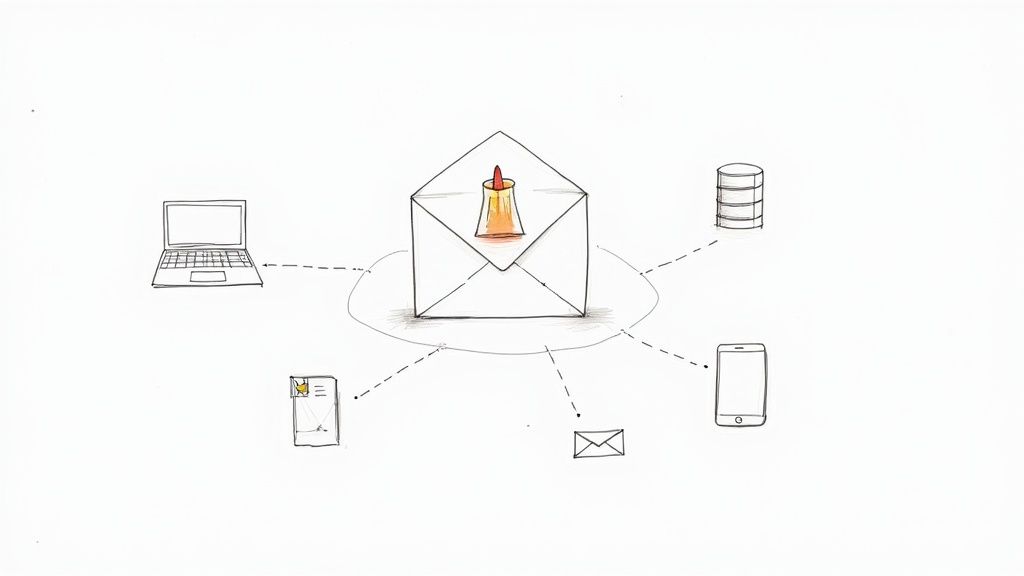
Images that help you visualize cadence shape
Here are a few visuals you can drop into a WordPress post so readers get it instantly.
1) Cadence density curve
2) Touch intent map
3) Deliverability guardrails checklist
If you do not have these images yet, you can replace the URLs with your own media library uploads later. The captions still stand.
Designing touches that do not feel like repeats
Most sequences fail because the touches are duplicates.
Different subject lines, same email.
Instead, think of each touch as a different angle.
Here are angles that typically work, in order:
Touch 1: The relevance claim
Purpose: show you are not random.
Structure:
- One line why them
- One line what you help with
- One question
Keep it short. You are not owed attention yet.
Touch 2: The nudge with a new micro detail
Purpose: catch people who missed it, add one more reason.
Add something small:
- a specific observation
- a tiny personalization
- a sharper problem statement
Avoid “bumping this”. That is just saying “I want attention”.
Touch 3: Proof
Purpose: reduce risk.
Proof can be:
- a mini case study (2 lines)
- a metric (careful, do not invent)
- a recognizable customer type
- a before/after statement
Do not paste a full case study. Nobody reads it.
Touch 4: Make it easy to say yes (or no)
Purpose: reduce friction.
Examples:
- two option CTA: “Worth a 10 min chat next week, or should I go away?”
- a simple qualifying question
- offer a one line audit result, if you truly have one
Touch 5: Breakup that is respectful
Purpose: protect brand and stop the bleed.
A good breakup:
- acknowledges timing
- restates value in one line
- gives a clean exit
- stops
A bad breakup:
- guilt
- fake scarcity
- “I will assume you are not the right person” (passive aggressive)
- “Last attempt” (sounds like a threat)
“Without getting muted” means you respect three quiet signals
People rarely tell you “stop”.
They just behave.
Three silent signals that should change your cadence logic:
- They opened but never replied
This is not always trackable. But if you have reply history signals, treat them as “needs a different angle” not “needs more volume”. - They clicked a link
If they clicked, do not keep hammering the same CTA. Switch to a softer follow up. Ask a question about what they cared about. - They replied with anything, even a no
Stop the automation. Always. Unless you are trying to speedrun a bad reputation.
This is where having an outbound platform that can actually manage rules, inboxes, and sequences cleanly matters. PlusVibe is built around this kind of operational reality, especially when you are running multiple inboxes with rotation and throttling. The “set it and forget it” sequences are how teams accidentally spam.
The hidden cadence killer: sending too many emails per day per inbox
Even if your sequence is perfectly paced, you can still get muted if your sending pattern looks unnatural.
Think about what a normal human does.
They do not send 300 nearly identical emails in a morning from one inbox.
Mailbox providers look at patterns, engagement, complaint rates. And your prospects also notice. Some of them can smell automation, even if you “personalized” the first line.
Practical guardrails:
- Keep daily sending per inbox conservative, especially on newer domains
- Ramp volume slowly
- Use inbox rotation if you need scale
- Verify emails so you are not bouncing
- Warm up inboxes before campaigns
This is exactly the boring plumbing PlusVibe focuses on: warm up to build sender reputation, bulk verification, multi inbox management, rotation, throttling. You do not need all of it on day one. But once you scale, you do.
A cadence framework you can implement today (with examples)
Here is a 5 touch email only cadence that works for a lot of B2B SaaS offers.
Touch 1 (Day 1): relevance + question
Subject: quick question about {{team}} and {{problem}}
Body:
Hi {{first_name}},
Noticed {{personal_observation}}. Quick question, how are you handling {{problem_area}} today?
If it is on your radar, we help {{persona}} reduce {{pain}} by {{mechanism}}. Open to a quick chat, or should I point this to someone else?
Thanks,
{{name}}
Touch 2 (Day 3): tighten the problem
Subject: re: {{problem_area}}
Hi {{first_name}}, following up with one detail I forgot.
Most {{persona}} we talk to run into {{specific_issue}} once {{trigger}} happens, and it turns into {{consequence}}.
Is that something you are seeing too, or not really?
{{name}}
Touch 3 (Day 6): proof
Subject: what we saw at {{similar_company_type}}
Hi {{first_name}},
For context, we recently worked with a {{similar_company_type}} team and they were dealing with {{problem}}.
After {{timeframe}}, they saw {{result}} (mainly by {{mechanism}}).
If you want, I can share the 2 or 3 steps we used. Worth it?
{{name}}
Touch 4 (Day 10): easy yes / easy no
Subject: should I close the loop?
Hi {{first_name}}, not sure if this is relevant right now.
If it is, are you open to a 10 min call next week?
If not, totally fine, just reply “no” and I will stop.
{{name}}
Touch 5 (Day 16): breakup
Subject: last note
Hi {{first_name}}, I will close this out after this message.
If improving {{outcome}} around {{problem_area}} becomes a priority later, want me to send a short checklist we use with teams to spot quick wins?
Either way, thanks for reading.
{{name}}
This cadence is not magical. It is just respectful. It gives multiple chances without acting entitled.
Where teams go wrong: they add channels, but not meaning
Multi channel is fine.
But most people do it like this:
- LinkedIn connect with no note
- LinkedIn message that copies the email
- Call with no context
- Another email
That is not multi channel. That is multi spam.
If you want to add channels, you need to assign them a different job.
Example:
- Email does the core pitch and CTA
- LinkedIn is used for light familiarity (view profile, follow, one genuine comment)
- Call is used only after an engagement signal (reply, click, “forward to”, etc.)
So a sane multi channel cadence might be:
- Day 1: Email 1
- Day 2: LinkedIn view + follow (no message)
- Day 3: Email 2
- Day 6: Email 3
- Day 7: LinkedIn connect with a simple note (optional)
- Day 10: Email 4
- Day 16: Email 5 breakup
Notice how LinkedIn is not used to dump the pitch again. It is just building recognition so email feels less random.
Cadence length: stop pretending there is one best number
“How many touches should I do?” is the wrong question.
Ask:
- How expensive is the sale?
- How saturated is the market?
- How strong is my trigger?
- How confident is my targeting?
- How fragile is my deliverability right now?
General guidance (not rules):
Low ticket B2B, fast decision
- 3 to 5 touches
- 7 to 12 days
- stop quickly
Mid market SaaS, moderate consideration
- 4 to 6 touches
- 12 to 20 days
- add proof and soft outs
Enterprise, multi stakeholder
- 6 to 8 touches
- 20 to 35 days
- multi thread, account based, fewer but stronger emails
- more manual intervention
If you are running pure cold at enterprise with a generic 12 step cadence, you are going to burn a domain. Or three.
Personalization is not “first line magic”. It is relevance plus restraint
Let’s talk about the personalization trap.
A lot of people think personalization means:
“Loved your post about leadership. Really inspiring.”
And then they pitch software.
That is not personalization. That is cosplay.
Real personalization is usually one of these:
- A trigger: hiring, funding, tech change, job change
- A strong fit: they match a niche where you win
- A clear observation: something on their site that implies a need
- A constraint: geography, stack, compliance, GTM motion
And then you do less. You write shorter. You do not over explain.
Because when relevance is strong, you do not need a long email.
The quiet factor: cadence design is also about writing style consistency
If Touch 1 is short and human, but Touch 3 is a 400 word corporate brochure, you feel automated.
If Touch 2 uses totally different tone, you feel like a different person hijacked the thread.
So keep a consistent voice across the sequence. Even if different angles.
Simple checks:
- Do your emails look like they came from the same human?
- Are you using the same sign off style?
- Are you suddenly adding calendar links later when you did not before?
- Are you suddenly using big marketing phrases later?
Consistency reduces “automation smell”. That helps you not get muted.
Deliverability friendly cadence design (yes, cadence affects this)
Most deliverability advice focuses on domain setup, authentication, warming. All important.
But cadence decisions matter too.
Here is how cadence and deliverability connect:
- More touches per prospect increases total volume
- Higher volume increases exposure to negative signals
- Frequent follow ups to non responders increases deletes and complaints
- Aggressive daily patterns can trip provider heuristics
So a deliverability friendly cadence does a few things:
- Keeps total touches reasonable
- Uses spacing so you are not “hammering”
- Stops when signals are negative
- Avoids sending to bad addresses (verification)
- Avoids sending too fast (throttling)
- Spreads volume across inboxes (rotation)
This is also where PlusVibe fits naturally if you are scaling outbound. Warm up to build sender reputation, bulk verification so you do not bounce, rotation and throttling so you send like a human, and campaign controls so you can actually pause or stop sequences when needed.
If your current setup cannot do those things, your cadence design is theoretical. In the real world, it breaks.
Choosing your “touch types” without being annoying
Let’s list touch types and what they are good for.
Best for: clear message, easy reply, trackable outcomes.
LinkedIn profile view / follow
Best for: light familiarity, zero friction.
LinkedIn connect (short note)
Best for: making the name less cold. Keep it simple. No pitch.
LinkedIn message
Best for: only after they connect or show interest. Otherwise it feels like spam.
Phone call
Best for: high intent accounts, or after engagement. Cold calling totally works, but as a strategy, not as a random step 4.
Loom video
Best for: high value prospects, small volume, real research. Not mass.
Referral / intro ask
Best for: when you have a real mutual connection and you are not abusing it.
A cadence that mixes these well has one thing in common:
It does not treat each touch as “another chance to pitch”.
Sometimes the best touch is just a nudge. Or a question. Or proof.
The “muted” moment usually happens when you remove the exit
People mute you when they feel trapped in your sequence.
So you design exits.
Exits look like:
- “If not relevant, tell me and I will stop.”
- “Who should I talk to instead?”
- “Is this a priority in Q1 or later?”
- “Want me to send the checklist, or should I close the loop?”
When you give someone an easy out, a surprising thing happens. They often respond.
Because now the reply is not a commitment. It is just a boundary. Humans like boundaries.
For those looking to diversify their outreach strategy, considering alternatives to traditional methods could be beneficial. You might explore some of the 10 best Outreach.io alternatives to choose in 2024, which offer innovative solutions that align with the aforementioned touch types while avoiding the pitfalls of being overly aggressive or intrusive.
Cadence segmentation: do not run one sequence for everyone
This is where things get fun, because it is also where reply rates jump.
Segment by:
- Persona (VP Sales vs RevOps vs Founder)
- Company size (SMB vs Mid market vs Enterprise)
- Trigger (funding vs hiring vs tech change)
- Region (timezone, holidays, work week differences)
- Industry (compliance heavy industries need different tone)
Then design small cadence variations:
- Same number of touches, different proof
- Different CTA (call vs “should I send info”)
- Different pacing (enterprise slower)
- Different channel mix
You do not need 50 sequences. You need like 3 to 6 strong ones.
A/B testing cadences without breaking your outbound system
Most people A/B test subject lines and call it optimization.
Better tests:
- Pacing test
5 touches in 12 days vs 5 touches in 18 days. - Angle sequence test
Proof on Touch 3 vs proof on Touch 2. - CTA test
Calendar link vs reply based scheduling. - Breakup style test
Checklist offer vs simple close out.
Rules for clean cadence tests:
- Keep list quality consistent
- Keep offer consistent
- Test one variable at a time
- Use reply rate and positive reply rate as primary metrics
- Watch spam complaints and bounce rate like a hawk
If your tooling supports it, run these tests inside your campaign engine with proper throttling and inbox rotation. This is another area where an outbound platform like PlusVibe is helpful, because you can manage multi inbox sending, A/B tests, and analytics without duct taping four tools together.
Cadence copy rules that keep you out of spam (and out of mute)
Quick list. Practical.
- Avoid heavy formatting, too many links, too many images in cold email
- Keep it mostly plain text
- Do not use hype words constantly (free, guarantee, act now)
- Keep subject lines normal, not clickbait
- Do not fake reply chains if you cannot pull it off naturally
- Do not “Re:” unless it is actually a reply in the same thread
- Always include an unsubscribe or at least a clear opt out line (depends on region and compliance)
Also. Verify your list. Bounces hurt.
Bulk verification is not glamorous. It is necessary.
The cadence design checklist (print this mentally before you launch)
Strategy
- What is the conversation type?
- Who is the persona and what do they care about this quarter?
- What is the one action we want?
Targeting
- What makes this list high intent or high fit?
- What is the trigger, if any?
- Have we removed risky domains or roles?
Sequence
- 4 to 6 touches, unless you have a strong reason
- Density early, space later
- Each touch has a different job (not a repeat)
- Clear stop point
Deliverability
- Inbox warm up is running
- Emails verified
- Throttling limits set per inbox
- Rotation enabled if scaling
- Copy is plain text-ish
Operations
- Reply handling rules exist (pause on reply, stop on no)
- A/B tests defined
- Metrics tracked (positive replies, spam complaints, bounces)
If you cannot check these boxes, fix that before you add “Touch 7”.
A subtle but important CTA: build cadences on top of stable sending
If you are reading this and thinking, “Okay, I get it, but managing warm up, verification, multi inbox rotation, throttling, campaigns, analytics… sounds like a lot.”
It is. And that is why all in one outbound platforms exist.
If you want one place to run deliverability safe cold outreach at scale, take a look at PlusVibe at https://plusvibe.ai
It is built for the unsexy parts that protect your ability to send. Warm up, deliverability optimization, bulk verification, inbox rotation and throttling, plus the campaign tooling to personalize, test, schedule, and analyze without turning your outbound into a fragile spreadsheet monster.
Wrapping up (the part people skip, but it matters)
Cadence design is not about being persistent.
It is about being intentional.
If you choose touches that each earn their spot, if you pace them like a human, if you stop when you should, you will get more replies. And you will keep your sender reputation clean enough to scale.
Which is the whole game, really.
Send fewer, better touches.
Space them well.
Respect exits.
Protect deliverability.
And you will stop getting muted.
FAQs (Frequently Asked Questions)
What is cadence design in cold outreach and why is it important?
Cadence design is the strategic planning of a sequence of touches—emails, calls, LinkedIn messages, etc.—in cold outreach. It determines how many touches to send, their timing, channels used, and the intention behind each. Proper cadence design ensures you engage prospects effectively without sounding robotic or desperate, ultimately increasing reply rates and protecting your sender reputation.
Why do most cold outreach cadences fail?
Most cadences fail because they treat each touch as identical units rather than unique steps with specific intentions. For example, Touch 1 should establish relevance, while Touch 5 might offer a graceful exit. Ignoring this leads to repetitive messaging that annoys recipients, resulting in muted threads and harming deliverability.
How does cadence design affect email deliverability and sender reputation?
An aggressive or poorly designed cadence can raise spam complaints, increase deletes without reading, trigger spam filters due to pattern repetition, and force higher sending volumes—all of which decay your domain reputation. This lowers deliverability, meaning fewer prospects see your emails regardless of copy quality.
What role does trust play in designing an effective outreach cadence?
Every outreach touch spends a small amount of trust from a prospect who doesn't know you yet. To maintain this trust, each touch must provide value—clarity, relevance, proof, or a meaningful ask. Without giving back value proportionate to the frequency of touches, you risk burning trust and getting muted.
How should I tailor my outreach cadence based on the type of conversation I'm starting?
Identify the conversation type before designing your cadence: Quick win/tactical offers require faster pacing and clear CTAs; curiosity-based approaches need slower pacing with more proof; high-consideration enterprise sales involve longer timelines and multiple channels; event-driven outreach uses short bursts with strong relevance; account expansion involves fewer steps with direct messaging. Tailoring cadence prevents mismatched messaging and improves engagement.
What does a good default cold outreach cadence look like?
A solid baseline for many B2B offers includes 4 to 6 emails over 10 to 18 days total, supplemented by 1 to 2 optional non-email touches like LinkedIn interactions. It features a clear stop point and a polite breakup message—not manipulative or pushy. Keeping it simple and consistent avoids overwhelming prospects and helps maintain deliverability.