ZoomInfo is the better pick for outbound prospecting. It is a standalone database you search to find people you have never contacted, with direct dials and org charts. Clearbit is now HubSpot Breeze Intelligence: it enriches records you already own and only makes sense if HubSpot is your CRM. But neither tool gets a single email into an inbox. Once you have the list, deliverability decides whether it turns into replies, and that is where outbound programs quietly fail.
Key Takeaways
- ZoomInfo is built to find new contacts and accounts. Clearbit, now part of HubSpot, is built to complete records you already have.
- There is no standalone Clearbit subscription to buy anymore. ZoomInfo is still sold on its own, on annual contracts that reported figures put in the tens of thousands of dollars.
- In one independent test, ZoomInfo led on valid emails, and the gap was far wider on phone numbers.
- Any purchased list still bounces to some degree. Verify addresses and warm up your sending infrastructure before you scale volume.
- Pick the data source by your motion (outbound or inbound), then protect the domains you send from.
Table of Contents
- What each tool is today
- The availability problem with Clearbit
- Data coverage and accuracy
- Prospecting, intent and workflow
- What each costs
- Which one for which team
- The step both comparisons skip: getting the email delivered
- Our perspective
- Where PlusVibe fits
- FAQ
- Sources
What each tool is today
ZoomInfo describes itself on its own site as an all-in-one go-to-market platform for sales, marketing, revenue operations and customer success teams. In practice, most outbound teams use it as a searchable database: filter by industry, company size, job title and location, then export contacts with emails and phone numbers into a CRM or a sequencing tool. Its product list also covers buyer intent, website visitor identification and a sales engagement layer.

Clearbit works the other way around. It was acquired by HubSpot in late 2023 and rebuilt inside HubSpot as Breeze Intelligence. It sits on top of records you already have, or on visitors already on your site, and fills in the missing fields: company size, industry, role and seniority. Its three core jobs are enrichment, website visitor identification and shorter forms, according to a June 2026 comparison from Leadhaste.
That difference is the whole comparison. Ask which problem you have:
- “We have run out of accounts to contact.” That is a prospecting problem, and ZoomInfo is built for it.
- “Leads come in, but the records are thin and we cannot see who visits.” That is an enrichment problem, and it is what Clearbit was built for.
The availability problem with Clearbit
Most older Clearbit-versus-ZoomInfo articles skip this, and it changes the decision. Clearbit is no longer a product you can sign up for on its own. According to Pipeline CRM’s integration notes (August 2026), new standalone Clearbit accounts can no longer be created, HubSpot points new customers to Breeze Intelligence, and the standalone enrichment API is on the same path, with keys working only on legacy accounts.
The dates reported for the wind-down, per Leadhaste’s July 2026 review:
| Change | Date |
|---|---|
| HubSpot acquires Clearbit | Late 2023 |
| Standalone free tools sunset | 30 April 2025 |
| Logo API sunset | 1 December 2025 |
| Basic contact and company enrichment free with paid HubSpot seats | Late 2025 |
If you do not run HubSpot, Clearbit is not a real option for you. If you do, Breeze Intelligence is a convenient way to keep your own records clean. It is not a way to find thousands of new prospects.
Data coverage and accuracy
ZoomInfo’s own data page states a database of 500M+ contacts and 100M+ company records, with 135M+ direct dial numbers, and claims a 96% email deliverability rate and 87% mobile number accuracy. Those are the vendor’s own figures and they describe the whole database, not your target segment.
For an independent view, CTO Rank’s May 2026 head-to-head test checked 200 known CTOs and VPs of Engineering. The results:
| Measure | ZoomInfo | Clearbit |
|---|---|---|
| Valid email | 78% | 72% |
| Correct current title | 71% | 68% |
| Phone number present | 65% | 31% |
| Correct current employer | about 75% | about 75% |
Two lessons follow. First, ZoomInfo leads, but not by a margin that makes its data safe to send to blindly: roughly one email in five in that test was not valid. Second, even the better tool was wrong about tech executives about a quarter of the time on some fields. Segment matters a great deal. If you target seed-stage startups or fast-turnover roles, expect thinner and staler records than the headline coverage numbers suggest.
The two also source data differently. One side leans on predicting email formats from company patterns and checking them against mail servers. The other pulls from community-contributed data, web crawling and partner feeds. Neither method is a guarantee that a given address is live today.
Prospecting, intent and workflow
If you do outbound, the feature gap is straightforward.
- Building lists. ZoomInfo lets you build lists from hundreds of attributes, such as technology stack and funding, and includes direct dials and org charts. Clearbit’s value is completing records as they arrive, and its prospecting functions are limited.
- Intent signals. ZoomInfo layers topic-based intent and website visitor identification on its database. Breeze Intelligence’s visitor identification is mainly company-level and, per Abmatic AI’s April 2026 mapping, the Reveal feature is partial and gated to higher HubSpot tiers.
- Integrations. Breeze is native to HubSpot. ZoomInfo connects to Salesforce and dozens of other tools.
HubSpot itself is moving prospecting into the CRM. Vantage Point reports that in April 2026 HubSpot embedded a third-party contact database in its Breeze Prospecting Agent, which requires a Professional or Enterprise HubSpot edition and runs on HubSpot Credits. The direction is clear: Clearbit’s lineage is becoming a layer inside the CRM, not a data store you can point at the open market.
What each costs
Neither vendor publishes a simple price for what most teams need, so budget from reported ranges and get a written quote.
- ZoomInfo prices on features, licenses, credit usage, add-ons and expected usage, according to its pricing page. Revenueflow’s August 2026 update records its February 2026 published ladder as Professional at $1,250 a month, Advanced at $2,083 and Elite at $3,333, with credits per year rather than unlimited. Other buyer-data reports put the median contract above $30,000 a year once seats and add-ons are counted. Our own ZoomInfo pricing guide goes through the model line by line.
- Clearbit/Breeze has no standalone price. You pay for a HubSpot subscription plus HubSpot credits. Leadhaste’s estimate for a realistic entry point is about $75 a month on annual billing, for around 100 enrichment credits. Credits scale quickly: a few hundred dollars a month for 1,000 credits is the range reported.
Whichever you choose, make the quotes comparable by asking what a credit reveals, whether the same contact consumes a credit again later, whether credits are pooled or per seat, and what year two looks like after a first-year discount.
Which one for which team
- Outbound sales team with SDRs, no HubSpot dependence: ZoomInfo. You need volume contact records and direct dials, and Clearbit cannot be bought standalone anyway.
- Inbound-heavy team that lives in HubSpot: Breeze Intelligence, to enrich the leads and accounts you already own.
- Agency running outbound for several clients: a contract in the tens of thousands of dollars per year is hard to justify per client. Many agencies assemble lists from several sources, enrich them and verify them. See our overview of B2B sales prospecting tools and the ZoomInfo alternatives we have compared by type of provider.
- Founder or small team: a seat-and-credit contract built for enterprise motions is likely more than you need. A smaller-scale list plus careful verification often does the job.
If you target the EU, route the plan through your data protection officer first. US-built contact databases carry GDPR legitimate-interest and notification obligations, and that is a legal question for a lawyer or DPO, not a vendor’s data sheet.
The step both comparisons skip: getting the email delivered
A contact record is not a conversation. The list is the first half of outbound. The second half is a sending setup that keeps you out of spam, and it is where the money is won or lost.
A bounce rate in the high single digits is enough to hurt a sending domain. Reported bounce rates for purchased contact data vary by source and segment, so treat every list as unverified until you check it yourself. Three habits protect your domains:
- Verify before you send. Run every exported list through email verification, whatever its source. PlusVibe verification is built into the platform, and there is a free email verification tool for quick checks.
- Enrich what is missing. If a list has names and companies but gaps elsewhere, lead enrichment fills the fields you personalize from.
- Warm up and isolate. Send from warmed mailboxes, on authenticated domains (start with SPF), and keep each client’s sending separate so one bad list does not damage another account.
Once replies start, what you do with them matters as much as the first email. A clear follow-up system turns interest into meetings, and this guide to lead nurturing strategies covers what happens after the first reply.
Our perspective
We built PlusVibe on one observation: the list is rarely what kills an outbound program. The inbox does.
Teams spend weeks comparing databases and then send from the same few domains, with no way to see where emails land. A better list does not fix that. Verified addresses, a healthy warm-up pool and isolated sending do.
That is why each agency client on our Agency plan gets its own sending server and dedicated IPs, so one client’s mistake never touches another’s reputation. Our warm-up pool is closed and shared by every customer, with bad senders removed and inboxes re-checked over time. Its peak warm-up bounce rate has never exceeded 0.1%. And our seed tests show where your real campaign emails land at Gmail, Outlook and other providers, so you do not have to trust a dashboard score.
Pick ZoomInfo or Breeze Intelligence for the data, on the evidence above. Then judge your sending on receipts, not vibes.
Yaro
Where PlusVibe fits
PlusVibe is a cold email platform built for deliverability at high volume: multi-step sequences, lead enrichment, email verification, a unified reply inbox, private infrastructure and placement tests in one place. You bring the list from whichever source you chose, and we handle everything from verification to the inbox.
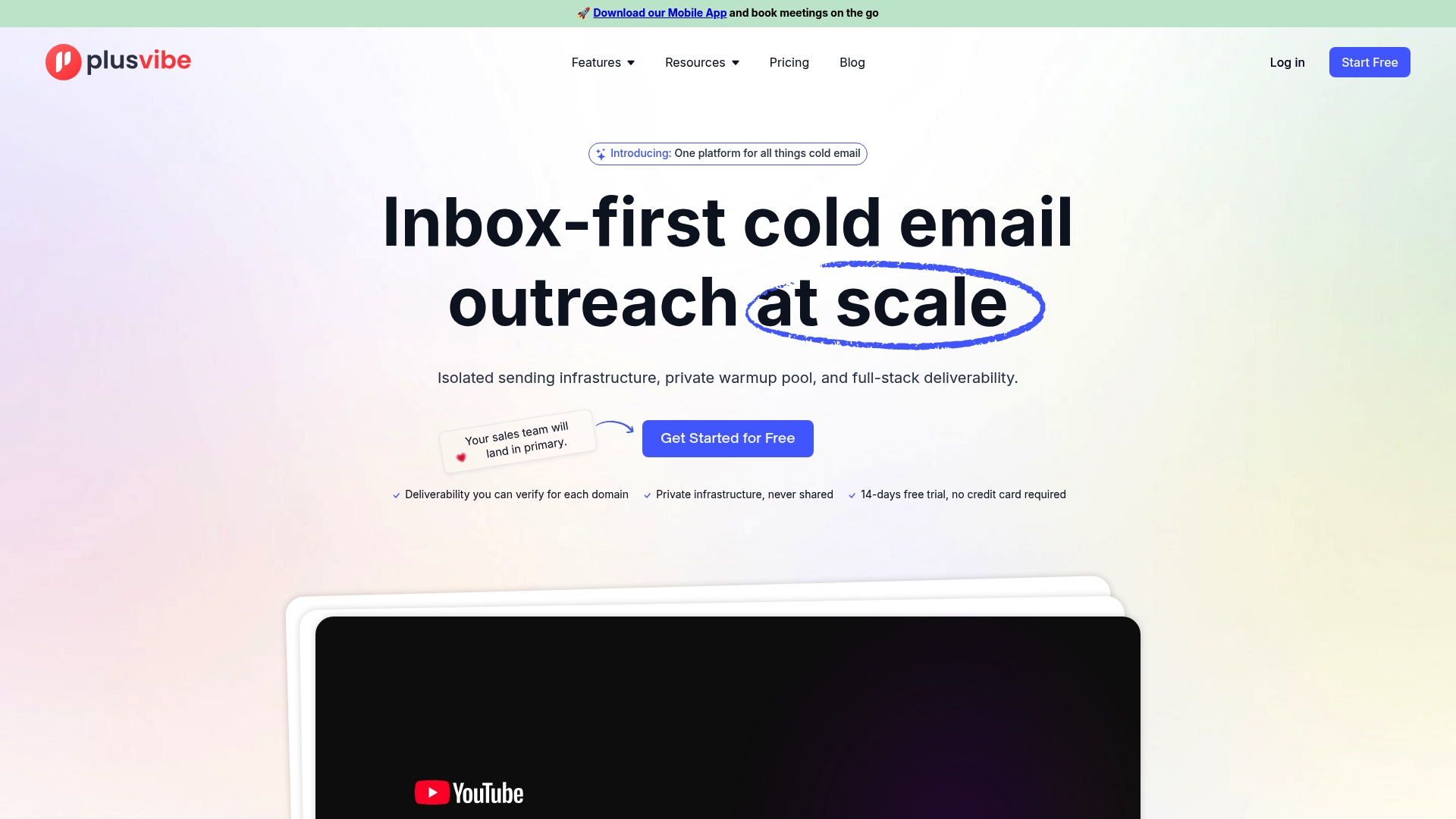
Plans start at $37 a month. Business is $77 a month for 150,000 emails, and Agency starts at $497 a month for 500,000+ emails, with no fee per connected mailbox. Compare them on the plans page, or start the 14-day free trial, no credit card required, and check placement for yourself. If you would rather not set up mailboxes, done-for-you email setup is available, and our deliverability page explains how placement works.
FAQ
Is Clearbit still available?
Not as a standalone product. HubSpot acquired it in late 2023 and rebuilt it as Breeze Intelligence, which is billed through HubSpot credits on top of a paid HubSpot subscription. New standalone accounts can no longer be created, so it is a realistic option only if HubSpot is already your CRM.
Is ZoomInfo better than Clearbit for cold outreach?
For finding new prospects, yes. ZoomInfo is a searchable database with direct dials and org charts, while Clearbit’s strength is enriching records you already hold. In CTO Rank’s 2026 test, ZoomInfo returned valid emails for 78% of contacts against 72%, and far more phone numbers.
How much does ZoomInfo cost?
It depends on seats, credits and add-ons, and it is sold on annual or multi-year contracts. Reported published tiers ran from $1,250 to $3,333 a month in early 2026, and reported median contracts sit above $30,000 a year. Get a written quote and ask what happens in year two.
Do I still need email verification if I buy a database?
Yes. Even in the best case in the test above, roughly one in five emails was not valid, and accuracy drops for startups and fast-changing roles. Verify every list before sending to protect your domains.
Sources
- ZoomInfo vs Clearbit: Which Is Better for Outbound in 2026?
- Clearbit Review 2026: Features, Pricing, and Honest Verdict
- Clearbit CRM Integration for Pipeline CRM
- Clearbit vs ZoomInfo: B2B Data Platforms Compared
- Clearbit vs ZoomInfo: Data Enrichment Tool Comparison
- Apollo Is Now Inside HubSpot’s AI Prospecting Agent