.jpeg)
Your inbox is a battleground. Day after day, it's flooded with generic, self-serving emails that are deleted in seconds. The difference between a pitch that gets ignored and one that sparks a career-defining conversation often comes down to the framework you use. Most cold emails fail because they are impersonal, focus on the sender, and offer no immediate value. They get caught in spam filters or, worse, earn a one-click trip to the trash.
To ensure your cold emails don't fall into this category, mastering effective email subject line best practices can significantly boost your open rates, giving your message a fighting chance. But a great subject line is only the first step. The real work begins in the body of the email.
This article isn't just another list of templates; it's a strategic deconstruction of 8 proven email pitch examples that consistently generate replies. We will dissect the psychology behind each approach, providing you with actionable takeaways and replicable methods to break through the noise. You will learn the mechanics behind successful outreach, from creating curiosity to building instant credibility. Let's dive into the examples that will get you noticed and get you replies.
1. The Problem-Agitate-Solve (PAS) Email Pitch
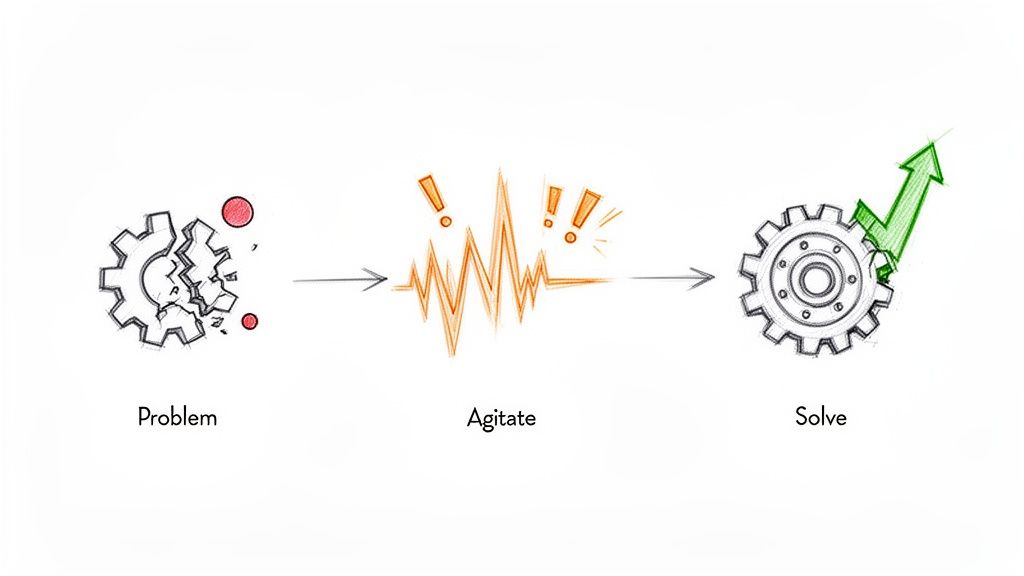
The Problem-Agitate-Solve (PAS) framework is a classic copywriting formula that excels in cold outreach because it taps directly into the prospect's world. This email pitch example works by first identifying a known pain point, then amplifying the negative consequences of that problem, and finally presenting your product or service as the logical solution. It shows you understand their challenges before you even mention what you sell.
Strategic Breakdown
PAS is effective because it creates an emotional connection by validating the prospect's frustrations. A sales development rep might target a small business owner struggling with inconsistent lead flow. The email would first state the Problem: "Getting a steady stream of qualified leads is a constant battle for many marketing agencies."
Next, it would Agitate by highlighting the consequences: "This often leads to unpredictable revenue, wasted ad spend on unqualified prospects, and your sales team sitting idle." Finally, it presents the Solve: "Our platform connects you with B2B clients actively searching for your exact services."
Key Insight: The "Agitate" stage is the most critical. It's where you transform a minor inconvenience into a significant business obstacle, making the need for a solution urgent and apparent.
Actionable Takeaways
To make your PAS email pitches more effective, apply these tactics:
- Use Data to Agitate: Instead of just describing the problem, quantify it. For example, "Did you know companies that don't follow up within 5 minutes lose 80% of their leads?" This adds credibility.
- Reference Specifics: Mention a detail from their LinkedIn profile or company blog to show your research. "I saw on your site that you're expanding your SEO services, which can make managing client reporting even more time-consuming."
- Keep the Solution Brief: Don't list every feature. Focus on the one key benefit that directly resolves the agitated problem. Your goal is to start a conversation, not close a deal in the first email.
By structuring your message this way, you move from a generic sales pitch to a targeted, empathetic conversation starter. For those looking to scale this personalized approach, exploring tools designed for advanced audience segmentation can be a great next step. Discover how you can build better campaigns with our guide to cold email automation.
2. The Curiosity Gap Email Pitch
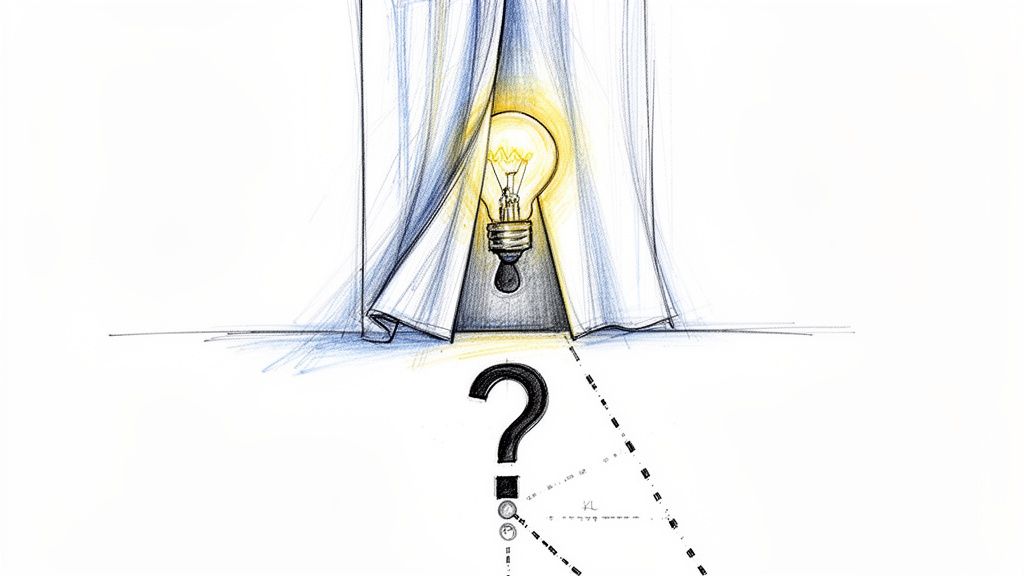
The Curiosity Gap framework is a powerful psychological trigger used in email pitch examples to get prospects to open and read your message. It works by creating a gap between what the reader currently knows and what they want to know. This method uses a surprising statistic, a counterintuitive claim, or an incomplete statement to compel the recipient to read further, making it especially effective for breaking through crowded inboxes.
Strategic Breakdown
This strategy is built on human nature; we are hardwired to seek answers and complete information. A sales professional might open an email to a marketing director with a targeted hook like, "One metric your team is probably overlooking is costing you $X annually." This statement immediately creates a knowledge gap. The recipient knows they are overlooking a metric but doesn't know what it is or how it's causing a financial loss.
The email would then briefly explain the context before revealing the answer, such as, "Our analysis shows that companies in your sector often track Cost Per Acquisition but miss Customer Lifetime Value decay." The pitch then smoothly transitions to the solution: "We developed a tool that surfaces these hidden insights."
Key Insight: The success of the Curiosity Gap depends on making a specific, believable claim that feels personal to the recipient. A generic statement is easily ignored, but a targeted one demands attention.
Actionable Takeaways
To make your Curiosity Gap email pitches more effective, apply these tactics:
- Research Competitors: Use specific achievements or strategies of the prospect's direct competitors to fuel curiosity. For example, "We found 3 companies in your industry growing 5x faster than you. Here's one reason why."
- Deliver the Payoff Quickly: Don't make the reader wait. Reveal the promised insight right after your hook. Delaying the payoff leads to frustration, not conversion.
- Test Your Hooks: The opening line is everything. Test different variations of your curious statement to see which ones generate the highest open and reply rates. What works for one audience may not work for another.
A compelling subject line is the first step in creating this curiosity. You can discover more strategies to craft irresistible openers by reading our guide to the best email subject lines.
3. The Social Proof Email Pitch
The Social Proof Email Pitch builds instant credibility by demonstrating that other similar companies already trust and value your solution. This approach is highly effective because it reduces the perceived risk for the prospect. Instead of just telling them you’re great, you’re showing them that their peers have already vetted you and achieved positive results. This creates a powerful sense of security and a fear of missing out (FOMO).
Strategic Breakdown
Social proof works by tapping into the psychological principle that people conform to the actions of others in an attempt to reflect correct behavior. When a B2B decision-maker sees that a direct competitor or a well-known brand in their industry is using your service, it immediately answers the question, "Is this for people like me?" An email might open by stating, "Over 400 mid-market SaaS companies, including [Competitor Name], trust us for lead generation."
This is far more persuasive than a generic claim. You can strengthen it with a specific metric, such as a testimonial that reads, "We increased qualified leads by 34% in 90 days after switching to your platform." The message shifts from "Here's what we do" to "Here's what we've already done for a business just like yours."
Key Insight: The power of this email pitch example lies in its specificity. Generic social proof ("our clients see great results") is weak. Targeted social proof ("SaaS companies like yours see a 34% increase in qualified leads") is compelling.
Actionable Takeaways
To execute the Social Proof pitch correctly, consider these tactics:
- Match Proof to Prospect: The most crucial rule is relevance. Use case studies from companies of a similar size, industry, and even location. Unrecognizable or irrelevant company names can dilute your credibility.
- Quantify Everything: Abstract benefits are forgettable. Use hard numbers that matter to your prospect, such as revenue growth, conversion rate improvements, or hours saved per week.
- Segment Your Outreach: Don't send the same case study to everyone. Segment your prospect lists by industry or company size and customize the social proof for each group to maximize its impact. For instance, you could use a prospect management tool to tag contacts by size for targeted proof delivery.
4. The Question-Based Email Pitch
The Question-Based Email Pitch flips the traditional sales dynamic by opening with a strategic question instead of a statement. This approach immediately engages the prospect's critical thinking and positions you as a consultative partner rather than a pushy salesperson. By prompting them to self-assess a potential problem, you guide them toward recognizing a need for your solution on their own terms.
Strategic Breakdown
This method is powerful because it encourages active participation. Instead of passively reading your claims, the recipient must mentally formulate an answer to your question. For a sales manager targeting a head of marketing, a pitch might start with the Question: "What's your current bottleneck in moving qualified leads through the pipeline?"
Next, the email provides brief Context, explaining the reason for asking: "I ask because many marketing leaders I speak with find that a slow handoff to sales causes lead decay." Finally, it offers a gentle Solution Bridge: "We built a tool that automates this handoff, ensuring every lead is contacted within five minutes."
Key Insight: The quality of your opening question determines the success of this entire pitch. An effective question is specific, relevant to the prospect's role, and open-ended, making it impossible to answer with a simple "yes" or "no."
Actionable Takeaways
To make your question-based email pitches more effective, apply these tactics:
- Research for Relevance: Use details from their LinkedIn profile, recent company news, or website to craft your question. For example, "I saw your company just launched a new enterprise software. How are you ensuring your sales team reaches the right decision-makers in those larger accounts?"
- Keep it Concise: The strength of this email pitch example is its brevity. The question should be the star of the show. Keep the total email under 150 words to maintain focus and respect the prospect's time.
- Test Your Angles: The best question isn't always obvious. Use A/B testing to try different question types. You might test a problem-focused question ("What's the biggest challenge with...") against a goal-focused one ("What's your main priority for...") to see which generates more replies.
By starting a dialogue with a thoughtful question, you shift the interaction from a monologue to a conversation. This consultative approach builds trust and significantly increases the likelihood of getting a meaningful response.
5. The Value-First Email Pitch
The Value-First email pitch flips the traditional sales script by immediately delivering useful information, insights, or resources with no strings attached. This approach builds goodwill and positions you as a helpful expert before you ever mention your product or ask for a meeting. It works on the principle of reciprocity, earning you the right to a prospect's time and attention.
Strategic Breakdown
This strategy is highly effective because it leads with generosity, disarming the recipient's natural sales resistance. Instead of asking for something, you are giving something. A sales rep might identify a specific, improvable area on a prospect's website. The email would then deliver Value upfront: "I noticed the images on your recent blog posts aren't compressed, which could be slowing down your page load speed by 2-3 seconds."
This value is immediate and tangible. The pitch then connects this insight to a business problem: "Faster load times often correlate with better SEO rankings and lower bounce rates." Only after providing this free advice does the sender make a small, low-friction Ask: "Is optimizing site performance a priority for you right now?" This is one of the most effective email pitch examples for building long-term relationships.
Key Insight: The value provided must be specific and genuinely helpful to the recipient's company or role, not just a generic industry tip. The goal is to prove your expertise, not just state it.
Actionable Takeaways
To make your Value-First email pitches land effectively, apply these tactics:
- Dedicate Research Time: Spend 10-15 minutes researching each prospect. Look for a broken link, a non-mobile-friendly webpage, or a recent company announcement you can connect to a relevant insight.
- Keep the Value Concise: Present your helpful tip in 2-3 sentences at the very beginning of the email. Don't bury your lead in the third paragraph.
- Soften Your Call to Action: Instead of asking for a 30-minute demo, close with a simple question like, "Does this resonate with what your team is working on?" to gently open a dialogue.
This method requires more effort per email, but it generates higher-quality responses and establishes trust from the first interaction. Understanding advanced techniques is key to making this scalable. For a deeper look, you can learn more about how to master cold email personalization.
6. The Story-Driven Email Pitch
The Story-Driven Email Pitch moves beyond features and benefits to create an emotional connection through a brief, relatable narrative. This email pitch example works by showing, not just telling, how a solution solves a problem. It uses a short client story to illustrate the transformation, making complex or abstract services more tangible and memorable for the prospect.
Strategic Breakdown
This approach is powerful because humans are wired for stories. A well-told mini-narrative can demonstrate the real-world impact of your offer in a way that a list of features cannot. For instance, a sales rep could target a marketing director by sharing the story of a similar professional who was struggling.
The email might start with a brief tale: "One of our clients, a marketing director like yourself, was frustrated with a lead generation process that was targeting the wrong personas. After implementing our system, they discovered where their best customers were hiding and boosted their qualified lead rate by 40% in just one month." This narrative instantly mirrors the prospect's likely challenges and presents a clear, desirable outcome.
Key Insight: The most effective stories focus on the "turning point" moment. Don't detail the entire journey; highlight the specific pivot from struggle to success to make the message concise and impactful.
Actionable Takeaways
To make your story-driven email pitches more effective, apply these tactics:
- Anonymize Real Stories: Use genuine client successes but anonymize names and company details to respect privacy. This keeps the story authentic without breaking trust.
- Keep the Narrative Short: Limit your story to two or three sentences. The goal is to hook the reader and start a conversation, not to present a full case study. Brevity maintains engagement.
- Include a Specific Metric: End the story with a quantifiable result. A concrete number like "reduced manual list-building time by 10 hours a week" is more compelling than a vague claim.
By weaving a short narrative into your outreach, you make your pitch more relatable and easier to recall. To master the art of crafting compelling messages, you can find more guidance on how to write cold emails that get results.
7. The Data-Driven Email Pitch
The Data-Driven Email Pitch leads with a compelling statistic or research finding to immediately establish credibility and grab the prospect's attention. This approach works exceptionally well for analytical audiences who value quantitative proof and ROI-focused arguments. By starting with hard data, you frame your outreach around an objective, industry-wide challenge rather than a subjective sales claim.
Strategic Breakdown
This strategy is powerful because it bypasses skepticism. Instead of asking a prospect to believe your claims, you present them with an undeniable fact from a credible source. A sales rep could use this method to target a Head of Operations by leading with a key industry benchmark: "Top performers in the logistics sector convert 3x more orders than average-here's why."
This immediately creates curiosity and positions the sender as an informed expert. The body of the email then connects that statistic to a specific pain point, like inefficient manual processes, before introducing a solution that helps them achieve a similar performance boost. The data isn't just a hook; it’s the foundation of the entire business case.
Key Insight: The most effective data points are those directly tied to a prospect's KPIs or industry. A statistic about revenue loss is more impactful for a CEO, while a stat about team productivity resonates better with a department manager.
Actionable Takeaways
To make your data-driven email pitch examples deliver results, integrate these tactics:
- Customize Data for Relevance: Whenever possible, use a statistic specific to the prospect's industry. Instead of "companies lose money," say, "89% of SaaS companies increased revenue by implementing process automation."
- Cite Your Sources: Add credibility and transparency by including a link to the report, study, or article where you found the data. This shows you've done your homework.
- Translate Data into Impact: Don't just state the fact; calculate its potential financial impact. For instance, "The average company loses $42,000 annually due to manual data entry errors. For a company your size, that could be over $100k."
This method transforms a cold pitch into a valuable, insightful piece of communication. To see how these principles apply in practice, review this collection of effective pitch email samples.
8. The Collaborative Problem-Solving Email Pitch
This approach reframes the traditional sales dynamic by positioning the sender as a partner rather than a vendor. Instead of pushing a product, this email pitch example acknowledges a potential challenge and proposes a joint effort to explore solutions. It's built on mutual discovery, making it exceptionally effective for consultative sales or services requiring custom implementation.
Strategic Breakdown
Collaborative problem-solving works because it lowers the prospect's guard. You aren't claiming to have all the answers; you're expressing genuine curiosity and offering to brainstorm. A sales professional might target a Director of Operations who recently oversaw a company merger. The email would first acknowledge the Challenge: "Integrating two different tech stacks after a merger can be a significant hurdle."
Next, it proposes a Collaborative Exploration: "I'm curious how you're approaching this. We've helped similar companies tackle post-merger integration, but every situation is unique." Finally, it suggests a low-commitment Next Step: "Would you have 15 minutes next week to compare notes and explore potential approaches?"
Key Insight: The power of this pitch lies in its language. Using phrases like "compare notes," "explore together," and "brainstorm" shifts the interaction from a sales presentation to a valuable, peer-to-peer discussion.
Actionable Takeaways
To execute your collaborative email pitches successfully, try these tactics:
- Do Your Homework: Identify a genuine, specific challenge. Referencing a recent company announcement, a new hire, or a market shift shows you've done more than superficial research.
- Ask Insightful Questions: Frame your pitch around a question that demonstrates your understanding. For example, "With your recent expansion into the EU, I imagine GDPR compliance for your user data is a top priority. How are you tackling that?"
- Commit to a Discovery Call: The goal is a conversation, not a demo. Your first call should be dedicated to understanding their unique situation. Prepare meaningful talking points to ensure the conversation delivers value even if they don't buy.
By opening the door to a partnership, you build trust and differentiate yourself from competitors. You can use advanced personalization tools to help identify and customize these challenge-based hooks at scale, making your outreach more relevant.
8 Email Pitch Types Comparison
| Pitch Type | 🔄 Implementation Complexity | ⚡ Resource Requirements | 📊 Expected Outcomes | 💡 Ideal Use Cases | ⭐ Key Advantages |
|---|---|---|---|---|---|
| The Problem-Agitate-Solve (PAS) Email Pitch | Medium — 3-part structure requires careful intensity tuning | Moderate — prospect research + personalization tools | Higher engagement; ~8–15% response when personalized | Consultants, agencies, SaaS targeting mid-market | ⭐ Emotional resonance, urgency, clear CTA lead-in |
| The Curiosity Gap Email Pitch | Low–Medium — craft a compelling, non-clickbait hook | Low — creative copy + subject-line testing | Strong opens and CTR; ~12–18% response with strong subject | Startups, innovative providers, inbox differentiation | ⭐ High open rates; concise and memorable |
| The Social Proof Email Pitch | Medium — gather and align relevant proof points | Moderate–High — case studies, testimonials, permissions | Builds trust; ~10–16% response; reduces perceived risk | Established SaaS, agencies, risk-averse buyers | ⭐ Fast credibility and FOMO when proof matches prospect |
| The Question-Based Email Pitch | Low–Medium — simple format but needs relevance | Low — targeted research to craft probing questions | Drives replies and conversation; ~9–14% response | Consultants, advisors, discovery-led sales | ⭐ Consultative tone that encourages two-way dialogue |
| The Value-First Email Pitch | High — requires bespoke, genuinely useful insights | High — deep research per prospect or AI-assisted enrichment | Strong reply rates and long-term relationships; ~14–22% | High-value B2B, consultants, technical service providers | ⭐ Builds trust via immediate value and reciprocity |
| The Story-Driven Email Pitch | Medium — needs concise, authentic storytelling skill | Moderate — quality copywriting and real client narratives | Highly memorable and engaging; ~11–17% response | Coaching, transformational solutions, premium services | ⭐ Emotional engagement and differentiation in inboxes |
| The Data-Driven Email Pitch | Medium–High — requires accurate, current data sourcing | High — research, citations, possible visuals or benchmarks | Credibility with analysts; ~10–15% response; clear ROI framing | Enterprise SaaS, finance, analytical decision-makers | ⭐ Quantified impact and persuasive ROI arguments |
| The Collaborative Problem-Solving Email Pitch | High — needs skilled reps and genuine discovery approach | Moderate–High — deep research + discovery-ready salespeople | Higher-quality meetings; longer sales cycles; ~12–18% | Consulting firms, custom implementations, premium B2B | ⭐ Builds trust and partnership orientation; fosters deeper deals |
From Examples to Execution: Your Next Steps
We've explored a wide array of powerful email pitch examples, from the directness of the Problem-Agitate-Solve framework to the subtle engagement of the Story-Driven approach. Each template offers a unique psychological angle for capturing attention and starting a meaningful conversation. However, the true value of these examples isn't in copying them word-for-word. It's in understanding the strategic foundation that makes them work.
The common thread connecting all effective pitches is a deep respect for the recipient's time and intelligence. This respect is demonstrated through diligent research, sharp personalization, and a clear, concise value proposition. The most successful outreach specialists don't just send emails; they deliver targeted, relevant solutions wrapped in a compelling narrative. They understand that a great pitch is less about selling and more about initiating a helpful dialogue.
Your Action Plan for Better Pitches
Viewing these email pitch examples is just the first step. True mastery comes from consistent, intelligent application. To turn these insights into tangible results, follow this structured plan:
- Select Your Frameworks: Don't try to use all eight templates at once. Choose two or three that best align with your service and the typical mindset of your ideal customer. A data-driven pitch might be perfect for a CFO, while a story-driven approach could resonate more with a creative director.
- Establish a Personalization System: Personalization is non-negotiable. Move beyond simply using
{FirstName}. Reference a recent LinkedIn post, a company announcement, or a shared connection. This simple act proves you’ve done your homework and separates your email from the flood of generic spam. - Implement A/B Testing: Your first draft is rarely your best. Create two versions of your chosen pitch, changing only one variable at a time. Test different subject lines, opening hooks, or calls to action to see what generates the highest open and reply rates. Data, not assumptions, should guide your strategy.
- Track and Analyze: Monitor your key metrics diligently. Pay close attention to open rates (which reflect subject line effectiveness), reply rates (which signal the strength of your core message), and positive reply rates (which measure true interest). These numbers tell the real story of your campaign's performance.
From Good to Great: The Next Level of Outreach
As you begin implementing these strategies, you'll discover that a successful cold email is a delicate balance of art and science. The art is in the crafting of your message, the empathy for your reader, and the authenticity of your voice. The science is in the testing, the data analysis, and the systematic refinement of your process. To further refine your strategy and ensure effective execution, explore more effective cold email examples that can significantly boost your outreach.
Building a system around these principles is what separates amateur efforts from professional-grade results. It’s about creating a repeatable engine for generating leads and building relationships, not just sending a few emails and hoping for the best. With the right frameworks and a commitment to testing, you can transform your cold outreach from a frustrating chore into a predictable and profitable growth channel.
Ready to put these email pitch examples into action at scale without sacrificing personalization or deliverability? PlusVibe combines AI-powered writing assistance with automated email warming and advanced analytics, ensuring your perfectly crafted messages land in the primary inbox. Stop guessing and start connecting by building your outreach engine on a platform designed for results.