You sent the email. Maybe two.
You even got that tiny dopamine hit when you saw an open. Then… nothing. No reply. No no thanks. No stop emailing me. Just silence.
And yeah, it happens to everyone. The SDR with the fancy sequences. The founder doing scrappy outbound at 11:47 pm. The agency owner who “knows email” but still gets ghosted by a perfect fit account.
This post is the playbook I wish someone handed me earlier. What to do when a prospect ghosts you, what not to do, and how to build a follow up system that gets replies without turning you into that person.
Also I’ll show you a few places where your tooling matters more than you think, especially deliverability. Because sometimes you are not being ignored. You are just not being seen.
First, let’s define “ghosted” (because it’s not always what you think)
A prospect ghosted you when:
- They did not reply after a reasonable number of follow ups.
- They engaged lightly (open, click, visited site, accepted connection) but still didn’t respond.
- They replied once then disappeared mid thread.
- They said “circle back next month” and then vanished when next month came.
But here’s the twist.
Sometimes “ghosted” really means:
- Your emails are going to spam or promotions.
- Your follow ups are landing, but they are too hard to respond to.
- You are emailing the wrong person.
- Your message is good, timing is bad.
- They intended to reply and forgot. Most common one.
So the goal isn’t to “win them back” with some clever line. The goal is to remove friction, fix visibility issues, and give them an easy out.
That’s it.
While dealing with prospects who have gone silent can be frustrating, it's essential to remember that this situation often arises from misunderstandings about the difference between a lead and a prospect. Understanding this distinction can significantly improve your approach and increase your chances of re-engaging with these potential clients successfully.
Step 1: Don’t follow up immediately. Wait like a normal human
If you sent the first email this morning and it’s 4 pm and you’re already itching to bump it… relax.
A simple timing baseline that works in most B2B:
- Follow up 1: 2 business days after the first email
- Follow up 2: 3 to 4 business days after that
- Follow up 3: 5 to 7 business days after that
- Follow up 4: 7 to 10 business days later
- Breakup email: after that
If it’s enterprise, stretch those windows. If it’s SMB and high velocity, you can compress slightly. But still. Give them breathing room.
Also, if your open tracking shows they opened 6 times in 10 minutes… do not send “Saw you opened.” Please. Just take the win silently and send a normal follow up later.
Step 2: Check deliverability before you assume disinterest
This is the quiet killer. And it’s why good outbound teams obsess over inbox placement.
If your domain is cold, your inbox is new, your copy is stuffed with spam triggers, your list is dirty, or you’re blasting too fast… you may be “ghosted” by the spam folder.
Things to check right now:
Are you warming up the inbox?
If you’re sending cold emails from a fresh inbox, you need warm up. Not optional.
PlusVibe includes customizable warm up settings that mirror normal business language and schedules, which matters because spam filters do not just read your words. They read your behavior.
Are you validating emails?
If you’re hitting invalid addresses or catching too many bounces, providers learn quickly.
PlusVibe has built in email validation (and enrichment and cleansing), which is exactly the boring stuff that saves campaigns.
Are you sending too many emails per day?
If you’re sending 200 per day per inbox, from a new domain, with links, you’re basically begging for deliverability issues.
One reason people like PlusVibe is you can connect unlimited inboxes. So instead of hammering one sender, you distribute volume safely.
Are spam complaints creeping up?
Even tiny complaint rates can hurt you.
PlusVibe claims <0.3% spam complaints and a 99.8% inbox hit rate when used right. I’d still treat those as targets, not guarantees. But the point stands. Deliverability is a system, not a vibe.
Step 3: Don’t just “bump” the thread. Add a reason to reply
“Just bumping this to the top of your inbox.”
That line has probably been responsible for millions of lost replies.
Your follow ups should do one of these:
- Add context: why you are reaching out, in one sentence.
- Add value: a useful idea, quick win, relevant resource, or observation.
- Reduce effort: make it easier to say yes, no, or later.
- Change angle: same offer, different hook.
- Confirm fit: “Should I be speaking to someone else?”
If your follow up does none of these, it’s basically noise.
Step 4: Use the 4 follow up framework (works stupidly well)
Here’s a simple sequence structure you can steal.
Email 1: The initial reach out
Short, specific, relevant. One clear question.
Email 2: The “did I miss the mark?” follow up
Polite, light. Gives them a graceful out.
Email 3: The value follow up
A relevant idea, quick audit, mini case study, or personal observation. Something they can use even if they never buy.
Email 4: The redirect
“Is this you, or should I talk to someone else?”
Email 5: The breakup
Close the loop. Remove pressure. Sometimes this gets the reply.
I’ll give you templates in a bit. But first, there’s something else.
Step 5: Diagnose why they ghosted (so you don’t repeat it)
When someone goes silent, it’s usually one of these buckets:
1) Not a priority right now
They might need you, just not this week. Or not this quarter.
2) Not the right person
You found a company match but not a role match. Classic.
3) Confused about what you do
Your offer is too broad. Or your email sounds like every other vendor.
4) Interested but skeptical
They want proof. Social proof, numbers, specifics, risk reversal.
5) They meant to respond and forgot
This is way more common than people like to admit. People are busy. They’re in back to back calls. Your email was “I’ll reply later” and then it’s gone.
6) You never reached them
Deliverability. Or you hit an inactive inbox. Or your message got clipped. Or your first line looked like a mass email and they deleted instantly.
The fix depends on the bucket.
So your follow up should be targeted.
Step 6: Rewrite your follow ups so replies are easy
This is the big one. People ghost when replying feels like work.
Make your CTA ridiculously easy to answer.
Good CTAs:
- “Worth a 10 min call next week, or not a priority?”
- “Should I close the loop, or revisit in Q3?”
- “Are you the right person for this, or is it someone on RevOps?”
- “If I send 3 bullets on what I’d change, would that be useful?”
- “Can you point me to who owns [problem]?”
Bad CTAs:
- “Would you be open to discussing synergies?”
- “Can we schedule 30 minutes to explore how we can drive value?”
- “Let me know your thoughts.” (thoughts on what, exactly)
When you give them an easy fork in the road, they pick one. When you ask them to think, they postpone.
Step 7: Change the channel (but don’t get weird about it)
If email is quiet, use a second channel. But do it lightly.
Options:
- LinkedIn: view profile, follow, like one post, then message.
- Phone: a quick call with a simple “caught you at a bad time?” opener.
- Referral inside the account: ask who owns the problem.
- Comment on a post: if it’s natural. Don’t force it.
The key is you’re not stalking. You’re just increasing surface area.
A good pattern is:
- Email follow up
- LinkedIn connection with a short note
- Another email
- Then a short LinkedIn message referencing the email thread
Keep it simple.
Step 8: Use personalization that actually feels personal (and do it fast)
Here’s the uncomfortable truth.
Most “personalized” emails are fake. You can smell it.
“Loved your recent post about leadership.”
No you didn’t.
Real personalization is specific and tied to your reason for reaching out:
- A recent hiring signal
- A product launch
- A tool in their stack
- A job post
- A quote from the CEO
- A workflow you can infer from their role
- A metric you can improve
PlusVibe leans hard into this with AI powered personalization, including hyper personalization with text, images, GIFs, and video, and using triggers like recent posts and company news.
If you can do that without spending 12 minutes per lead, great. That’s the whole game. Relevance at scale.
If you can’t, keep it simple. Even one clean line is enough.
Step 9: Add a pattern interrupt (without trying to be a comedian)
Sometimes your follow ups get ignored because they look like every other follow up.
A pattern interrupt is something that breaks the scan.
Examples that work:
- A one line email with a binary question
- A short “permission” email
- A direct “should I stop?” breakup
- A tiny audit screenshot
- A 15 second Loom video
Don’t overdo it. One interrupt per thread is plenty.
If you use images or GIFs, do it with intention. PlusVibe supports that kind of media personalization, which can lift replies when used sparingly.
Step 10: Send a breakup email (yes, really)
A breakup email is not passive aggressive. It’s closure.
It works because:
- It removes pressure.
- It gives them an easy way to respond.
- It creates urgency without being pushy.
Here’s the rule.
Your breakup email should be calm. Not “I guess you’re not interested.” Not guilt. Not sarcasm.
Just… a close.
Use these as starting points. Adjust for your voice.
Template 1: Follow up #1 (simple bump but with context)
Subject: Re: quick question about {{topic}}
Hi {{firstName}} quick bump on this.
The reason I reached out is we’ve been helping {{similarCompany}} reduce {{pain}} by {{specificMechanism}}.
Is this something you’re even thinking about this quarter, or should I close the loop?
Thanks,
{{yourName}}
Template 2: Follow up #2 (did I miss the mark?)
Hi {{firstName}} did I miss the mark here?
If it’s a “not now” or “not you” situation, totally fine. Just tell me and I’ll stop reaching out.
{{yourName}}
Template 3: Follow up #3 (micro value, 3 bullets)
Hi {{firstName}} quick idea based on {{trigger}}.
If I were trying to improve {{goal}} at {{company}}, I’d look at:
- {{bullet}}
- {{bullet}}
- {{bullet}}
If you want, I can share what this looks like for teams similar to yours. Worth a quick chat?
{{yourName}}
Template 4: Follow up #4 (who’s the right person?)
Hi {{firstName}} not sure if you’re the right person for {{topic}}.
Is this owned by you, or someone in {{team}}?
If you point me to the right person, I’ll reach out and leave you alone.
Thanks,
{{yourName}}
Template 5: Breakup email (close the loop)
Hi {{firstName}} I haven’t heard back, so I’m going to assume timing isn’t right.
I’ll close the loop on my side. If you want to revisit later, reply with “later” and I’ll follow up in a few months.
Either way, appreciate it.
{{yourName}}
Template 6: After they replied once, then ghosted mid thread
Hi {{firstName}} circling back on this thread.
Still makes sense to pick this up, or should I pause?
{{yourName}}
Template 7: The “two options” email (works for busy execs)
Hi {{firstName}} quick one.
Should we:
- book 10 minutes to see if this is relevant, or
- park it for now?
Either answer is helpful.
{{yourName}}
That one drives people crazy.
Usually it means:
- Curious, but not compelled.
- Interested, but unsure who you are.
- They clicked on your site, didn’t instantly see relevance, left.
- They forwarded it internally.
What to do:
- Follow up with a single question tied to the click.
“Curious, were you looking at {{page}} because {{reason}}?” - Offer a next step that is not a meeting.
“Want me to send a 60 second Loom walking through the idea?” - Add proof.
A quick example. A number. A result.
Also, if you’re running sequences, make sure your tool shows you clean campaign metrics. PlusVibe’s dashboard focuses on stats and analysis, which helps you see patterns fast. Like a specific step causing drop off.
Different situation.
If someone took a call then disappeared, it’s usually:
- Internal priorities shifted.
- They got spooked by pricing.
- They need stakeholder buy in.
- They’re evaluating alternatives.
- They didn’t feel urgency.
You need a tighter post meeting follow up.
Here’s a simple one:
Subject: Next steps
Hi {{firstName}} thanks again for today.
To recap, you mentioned {{pain}} and the main goal is {{goal}} by {{date}}.
Next step I suggest: {{specificNextStep}}.
If that sounds right, are you okay with {{twoTimeOptions}}?
If priorities shifted, also fine. Just tell me and I’ll pause.
{{yourName}}
If they still ghost, send a breakup 5 to 7 business days later that offers an out and a future re engage option.
This is common. And it’s not always a brush off. People forget what they even agreed to.
Send the follow up with context and a small reminder:
Hi {{firstName}} you mentioned I should reach back out around now.
Still the right time to revisit {{topic}}, or should we push it out?
{{yourName}}
Keep it that simple.
1) Sending long follow ups
If your follow up is longer than your original email, you lost the plot.
2) Asking multiple questions
Pick one. Maybe two. Not five.
3) Sounding needy
“I would really appreciate a response.”
No.
4) Over explaining your product
Your email is not a demo.
5) Following up forever
If you sent 9 follow ups, you’re not persistent. You’re background noise.
A good cap for cold outbound is usually 4 to 6 touches via email, plus maybe a LinkedIn touch or two.
If you want something you can implement today, here’s a clean 10 day plan.
Day 1: Initial email
Day 3: Follow up #1 (context + easy CTA)
Day 6: Follow up #2 (did I miss the mark?)
Day 8: Follow up #3 (3 bullets value)
Day 10: Follow up #4 (who owns this?)
Day 14: Breakup email
Then stop. Put them into a nurture list and revisit later with a new trigger.
You prevent ghosting by doing three things well.
1) Deliverability that does not sabotage you
Warm up. Validate. Control volume. Keep complaints low.
This is where platforms like PlusVibe are built for the job, with deliverability controls, warm up, unlimited inbox connections, and list hygiene baked in. It’s not sexy, but it’s the difference between “no one replies” and “we booked meetings this week.”
2) Relevance that does not feel fake
Use real triggers. Recent posts. Hiring. News. Stack. Role specific pain.
PlusVibe’s enrichment and AI personalization can speed this up a lot. Especially if you’re trying to personalize with more than just {{firstName}}.
3) A CTA that takes 2 seconds to answer
Binary questions. Easy outs. Small asks.
If you do those three, you still get ghosted sometimes. But way less.
A few relevant images you can add to this post
These are placeholders you can swap for your own screenshots (recommended), but they show where visuals fit naturally.
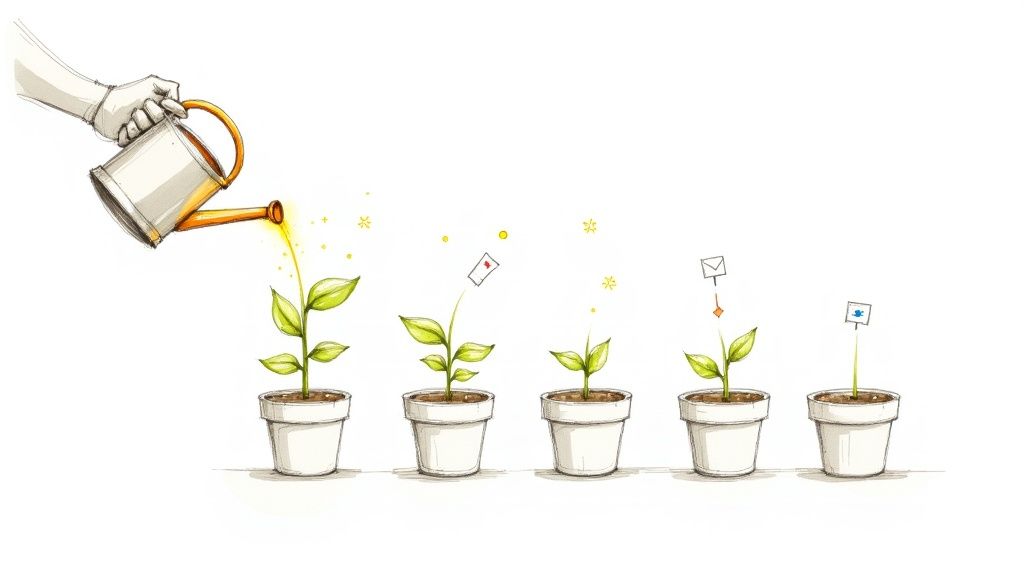
1) Example of a simple follow up sequence flow
2) Deliverability checklist graphic
3) Example dashboard metrics screenshot (open, reply, positive reply)
4) Example personalization snippet using a trigger
If you’re publishing on WordPress, try to use real screenshots from your own platform or process. It reads more real. People trust it more.
How many follow ups before I stop?
Usually 4 to 6 emails total, depending on deal size and ICP. Then stop and move them to nurture.
What’s the best day and time to follow up?
There’s no magic time, but Tue to Thu during business hours tends to be solid. If you have a global audience, segment by timezone. Tools that support scheduling per inbox help a lot here.
Should I call them out for ghosting?
No. Don’t say “why are you ghosting me?” It makes it emotional. Keep it practical.
Should I use humor?
Only if it’s your natural voice. Forced jokes hurt more than they help.
If a prospect ghosted you, do this:
- Wait a reasonable amount of time.
- Check deliverability and list quality before blaming your message.
- Follow up with a reason, not a bump.
- Make replying easy with a binary CTA and an easy out.
- Change angle. Change channel. Ask who the right person is.
- Send a calm breakup email and move on.
And if you want the boring parts handled, warm up, validation, enrichment, personalization, multi step sequences, that’s basically what PlusVibe is built for. If you’re curious, you can start with the 14 day free trial and test it on a small segment first. No heroics. Just clean data, good deliverability, and a tight follow up system.
That’s how you stop getting ghosted. Or at least stop taking it personally.
FAQs (Frequently Asked Questions)
What does it mean when a prospect 'ghosts' you in email outreach?
A prospect is considered 'ghosted' when they do not reply after a reasonable number of follow-ups, engage lightly (like opening or clicking but not responding), reply once then disappear mid-thread, or say they'll circle back later but vanish when that time comes. Sometimes, being 'ghosted' also means your emails are going to spam, your messages are hard to respond to, you're emailing the wrong person, timing is off, or they simply forgot to reply.
How should I space out my follow-up emails to avoid overwhelming prospects?
It's important not to follow up immediately. A good B2B timing baseline is: Follow up 1 two business days after the first email; Follow up 2 three to four business days later; Follow up 3 five to seven business days after that; Follow up 4 seven to ten business days later; and finally, a breakup email if no response. For enterprise clients, stretch these windows; for SMBs with high velocity, compress slightly. Always give prospects breathing room and avoid sending multiple follow-ups too quickly.
Why might my emails be getting no replies even if prospects open them?
Your emails might be landing in spam or promotions folders due to poor deliverability. Factors include sending from a cold domain or new inbox without warming it up, using spam-triggering language, having invalid email addresses on your list causing bounces, sending too many emails per day from one inbox, or accumulating spam complaints. Checking and improving these areas can significantly increase your chances of being seen and replied to.
What strategies can I use in follow-up emails instead of just 'bumping' the thread?
Instead of simply bumping the thread with lines like 'Just bumping this to the top of your inbox,' your follow-ups should add context (why you're reaching out), add value (a useful idea or resource), reduce effort (make it easy for them to say yes/no/later), change angle (different hook for the same offer), or confirm fit (ask if you should speak with someone else). This approach removes friction and encourages replies.
Can you explain the 4-follow-up email framework that improves response rates?
Yes! The framework includes: Email 1 - initial reach out that's short and specific with one clear question; Email 2 - a polite 'did I miss the mark?' asking for a graceful out; Email 3 - providing value like an idea or mini case study they can use regardless of purchase; Email 4 - redirecting by confirming if you should talk to someone else; and Email 5 - a breakup email that closes the loop without pressure and sometimes prompts a reply.
How does understanding the difference between a lead and a prospect help when dealing with ghosting?
Recognizing the distinction between leads and prospects helps tailor your outreach effectively. Leads are potential contacts who may not yet be qualified or ready, while prospects have shown some interest or fit your ideal customer profile. Misunderstanding this can lead to chasing unqualified contacts who won't respond. By focusing on genuine prospects and adjusting your approach accordingly, you improve engagement and reduce instances of ghosting.